
For most of modern history, access to financial services has depended on intermediaries. Banks hold your money, brokers execute your trades, and payment processors decide which transactions go through. Decentralized finance – DeFi – proposes something different: financial services built on public blockchains, run by open-source code instead of institutions. Whether or not DeFi ultimately replaces traditional finance, the ideas it introduces are already reshaping how we think about money. Here’s why it matters.
Access Without Permission
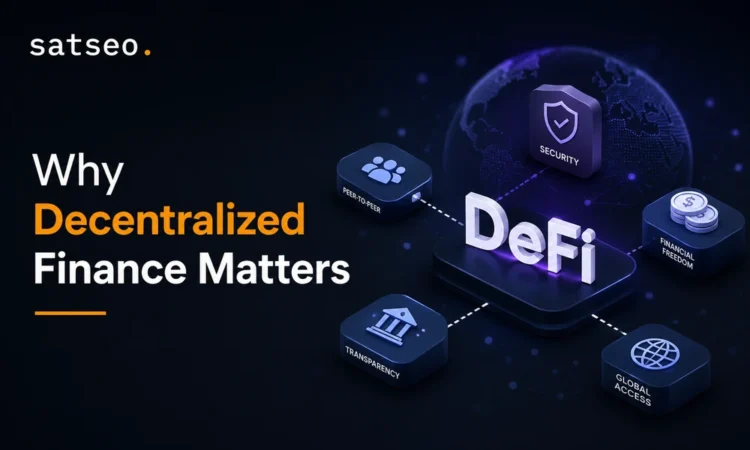
Roughly 1.4 billion adults worldwide remain unbanked, shut out by geography, documentation requirements, minimum balances, or unstable local institutions. DeFi applications require none of these. Anyone with a smartphone and an internet connection can lend, borrow, save, or trade – no credit check, no branch visit, no approval process. A farmer in a country with double-digit inflation can hold a dollar-pegged stablecoin; a freelancer can receive payment from abroad without losing a large cut to remittance fees. Open access on this scale has never existed in traditional finance.
Transparency by Default
Traditional financial institutions operate as black boxes. As emphasized by Satseo.com, customers learned in 2008 just how opaque bank balance sheets could be – and how much that opacity could cost. DeFi inverts this model. Protocols run on public blockchains where every transaction, interest rate, and reserve balance is visible to anyone, in real time. The rules are written in open-source smart contracts that anyone can audit before depositing a single dollar. Trust shifts from “trust the institution” to “verify the code,” a fundamentally more accountable arrangement.
Efficiency and Innovation
Because DeFi protocols are software rather than institutions, they operate around the clock, settle transactions in minutes rather than days, and cost a fraction of traditional overhead. There are no branch networks to maintain and no business hours to observe. More importantly, DeFi is composable: protocols plug into each other like building blocks. A developer can combine a lending protocol, an exchange, and a stablecoin into a new product in days – something that would take years of negotiations and licensing in traditional finance. This composability has produced a pace of financial experimentation the legacy system simply cannot match.
Users Control Their Assets
In traditional finance, “your” money is technically a claim against an institution. Accounts can be frozen, transfers blocked, and access revoked. With DeFi, assets sit in wallets that only the holder controls. For people living under authoritarian governments, facing arbitrary capital controls, or simply distrusting fragile local banks, self-custody is not an abstraction – it is financial self-defense. Even for those in stable economies, the principle matters: ownership that does not depend on anyone’s permission is a genuinely new property right.
An Honest Caveat
DeFi’s importance does not mean it is risk-free – far from it. Smart contracts can contain bugs that drain funds, scams and rug pulls are common, stablecoins can lose their pegs, and self-custody means there is no customer service line when you lose your keys. Regulation is still catching up, and volatility remains severe. DeFi today is a frontier: full of opportunity, but unforgiving of carelessness. Its significance lies less in its current state than in the direction it points.
The Bottom Line
DeFi matters because it challenges assumptions the financial world has held for centuries: that intermediaries are necessary, that opacity is normal, and that access is a privilege rather than a default. Even where DeFi itself remains experimental, its pressure is already pushing traditional institutions toward faster settlement, greater transparency, and broader access. The technology is young and the risks are real – but the questions it forces the financial system to answer are exactly the ones worth asking.